

Ashwagandha
Ashvagandha Withania somnifera
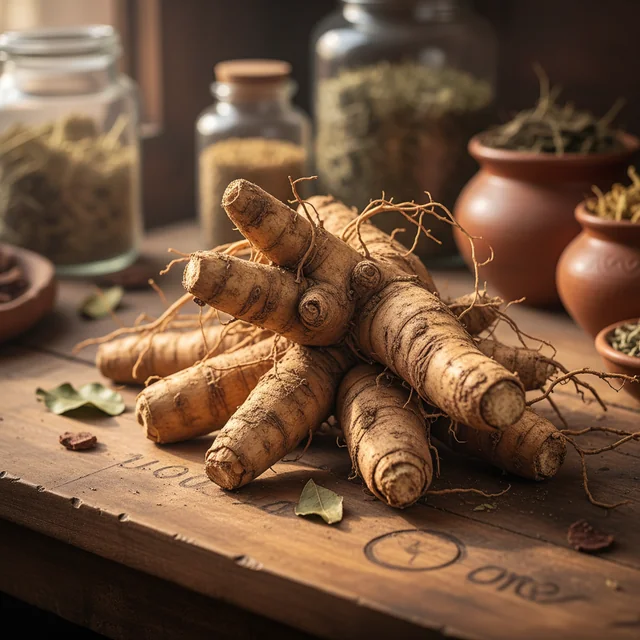
Ashwagandha is a well-known Ayurvedic herb traditionally valued for its root. It has a strong earthy smell and is presented here only for general traditional education.
बल्यं रसायनं वृष्यं जीवनीयं बृहणं स्मृतम्।
balyaṁ rasāyanaṁ vṛṣyaṁ jīvanīyaṁ bṛhaṇaṁ smṛtam.
Traditional context
A prominent plant in Ayurveda materia-medica. Traditional importance is presented as provenance, not proof of a modern health outcome.
Traditional description
Evidence boundary
Human studies use varied preparations and many are small. Kriyasya does not generalize a study result to every product or health condition.
What varies. Evidence and safety can vary by species identity, plant part, preparation, product quality, exposure, population, medicines and health conditions.
How to read this
Read this as cultural and traditional context, not as a recommendation to take anything. For personal use, consult a qualified practitioner.
Comprehensive Monograph & Research
Ashwagandha: The Grounding Herb for Vitality and Calm
Ashwagandha, also known as Withania somnifera, is a revered herb in Ayurveda, celebrated for its ability to rejuvenate and balance the body. Often referred to as 'Indian ginseng,' it is known for its grounding and calming properties, making it a popular choice for those seeking to manage stress and promote restful sleep. The name 'Ashwagandha' translates to 'smell of a horse,' indicating its traditional belief to impart the strength and vitality of a stallion. In Ayurvedic practice, Ashwagandha is classified as a Rasayana, which means it is used to promote longevity, vitality, and overall well-being. Its warming nature helps to balance Vata dosha, which is associated with movement and change, and can often lead to feelings of anxiety and restlessness when out of balance. By calming Vata, Ashwagandha helps to ground the mind and body, fostering a sense of stability and peace. This herb is also known for its ability to support the body's resilience against stress, thanks to its adaptogenic properties. Incorporating Ashwagandha into your daily routine can be as simple as adding it to warm milk or herbal teas, providing a soothing ritual that supports relaxation and rejuvenation.
Add a teaspoon of Ashwagandha powder to warm milk or herbal tea before bedtime to promote relaxation and restful sleep. It can also be blended into smoothies or mixed with honey for a nourishing treat.
अश्वगंधा: ऊर्जा और शांति के लिए एक अद्भुत जड़ी-बूटी
अश्वगंधा, जिसे विथानिया सोम्निफेरा भी कहा जाता है, आयुर्वेद में एक प्रसिद्ध जड़ी-बूटी है, जो शरीर को पुनर्जीवित और संतुलित करने की क्षमता के लिए जानी जाती है। इसे अक्सर 'भारतीय जिनसेंग' कहा जाता है, और यह अपनी स्थिरता और शांत करने वाली विशेषताओं के लिए प्रसिद्ध है, जो तनाव को प्रबंधित करने और अच्छी नींद को बढ़ावा देने के लिए एक लोकप्रिय विकल्प बनाती है। 'अश्वगंधा' का अर्थ 'घोड़े की गंध' है, जो इसकी पारंपरिक मान्यता को दर्शाता है कि यह घोड़े की ताकत और ऊर्जा प्रदान करती है। आयुर्वेदिक प्रथाओं में, अश्वगंधा को रसायन के रूप में वर्गीकृत किया गया है, जिसका अर्थ है कि इसका उपयोग दीर्घायु, ऊर्जा और समग्र कल्याण को बढ़ावा देने के लिए किया जाता है। इसकी उष्ण प्रकृति वात दोष को संतुलित करने में मदद करती है, जो गति और परिवर्तन से जुड़ा होता है, और असंतुलित होने पर चिंता और बेचैनी की भावना पैदा कर सकता है। वात को शांत करके, अश्वगंधा मन और शरीर को स्थिरता और शांति का अनुभव कराती है। यह जड़ी-बूटी तनाव के खिलाफ शरीर की सहनशीलता को भी समर्थन देती है, इसके अनुकूलनशील गुणों के कारण। अश्वगंधा को अपनी दैनिक दिनचर्या में शामिल करना उतना ही सरल हो सकता है जितना कि इसे गर्म दूध या हर्बल चाय में मिलाना, जो विश्राम और पुनर्जीवन का समर्थन करने वाली एक सुखदायक प्रक्रिया प्रदान करता है।
रात को सोने से पहले एक चम्मच अश्वगंधा पाउडर को गर्म दूध या हर्बल चाय में मिलाएं, यह विश्राम और अच्छी नींद को बढ़ावा देता है। इसे स्मूदी में मिलाया जा सकता है या शहद के साथ मिलाकर एक पौष्टिक मिठाई के रूप में लिया जा सकता है।
Safety context
This is educational information only. No dosage is given and no health outcome is claimed. Ashwagandha should not be self-used casually, especially in supplement form.
If pregnant or breastfeeding, do not self-use herbs; consult a qualified professional first.
Herbs can interact with medication. Speak with a professional before use if you take any medicine.
Supplement use has short-term safety data but limited long-term certainty; current NIH guidance includes pregnancy/breastfeeding, surgery, thyroid/autoimmune, medicine-interaction and rare liver-injury cautions.
Should not self-use: Pregnant or breastfeeding people; Anyone on medication; Anyone with a medical condition; Anyone with thyroid, liver, hormone-related, or immune-related concerns
Consult: A qualified Ayurveda practitioner or healthcare professional
No dosage, preparation strength or symptom-to-herb recommendation is given here.