

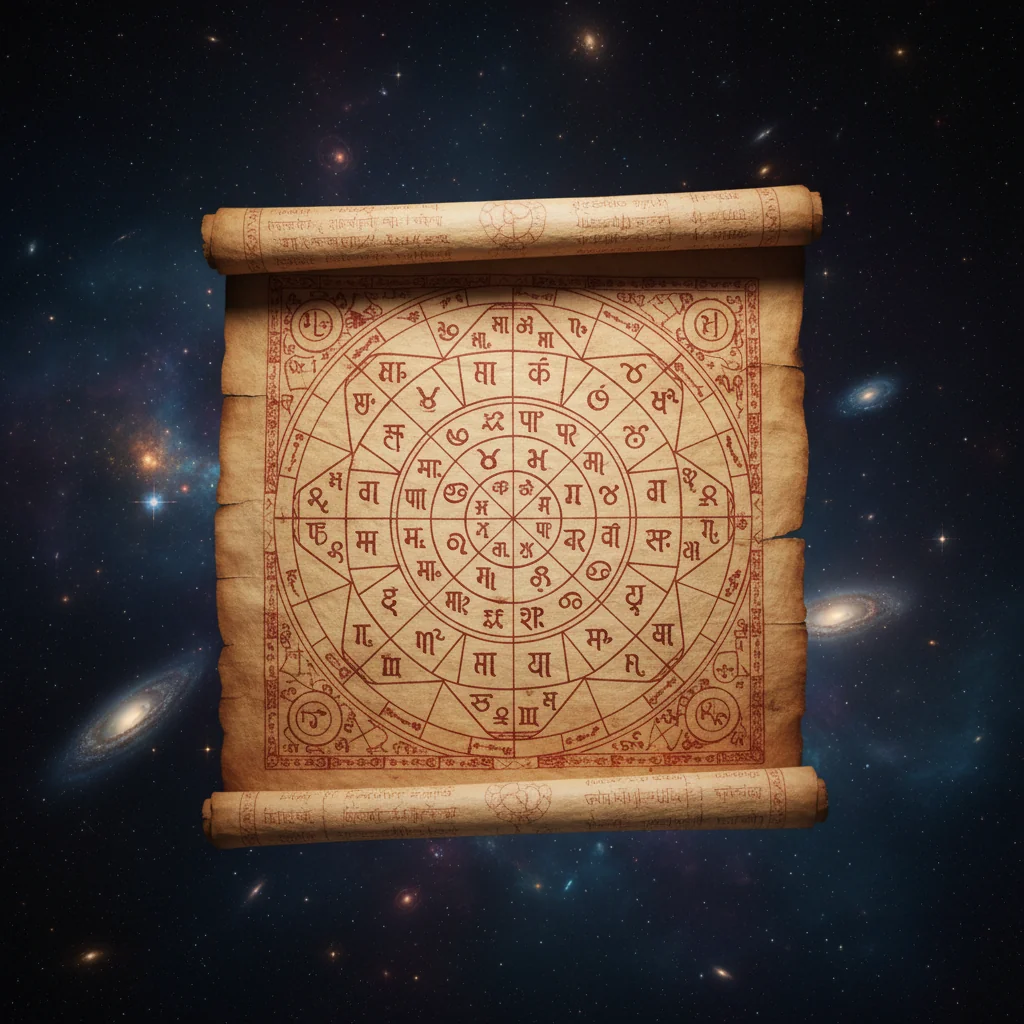
In the foundational framework of Parashari astrology, Parivartana Yoga (mutual reception or exchange of signs between two planetary bodies) represents the intimate interweaving of two distinct life departments. As declared by Maharishi Parashara in Brihat Parashara Hora Shastra (Chapter 38), an exchange of houses creates a profound energetic circuit where each planet acts as the custodian and amplifier of the other’s agenda.
शास्त्रीय प्रमाणम् (Classical Sanskrit Reference):
« अन्योन्यर्क्षगता भावाः परिवर्तनलक्षणाः। महाखलदैन्यभेदेन त्रिधा प्रोक्ता महर्षिभिः॥ »
— Brihat Parashara Hora Shastra, Parivartana Adhyaya
भावार्थ (Scholarly Interpretation): When planets occupy each other’s signs, Parivartana Yoga is established. Ancient seers classify these exchanges into three grand categories: Maha Parivartana (30 varieties among auspicious houses), Khala Parivartana (8 varieties involving the 3rd house), and Dainya Parivartana (28 varieties involving the 6th, 8th, or 12th houses).
Detailed Classical Delineation
Analyzing combustion, planetary war (Graha Yuddha), and nodal afflictions that disrupt mutual house reception.
From over thirty years of analyzing horoscopes across clinical consultations, an astrologer learns that a Parivartana Yoga operates like a mutual tenancy agreement. When transit planets trigger either participant, both houses experience simultaneous activation. This explains why natives with strong exchanges experience life shifts that concurrently transform their career and home, or their finances and relationships.
Taxonomy of Parivartana Combinations
| Category | Houses Involved | Expected Result |
|---|---|---|
| Maha Parivartana (30 Types) | Kendras (1, 4, 7, 10), Trikonas (5, 9), and Dhana houses (2, 11) | Massive wealth, executive authority, high moral stature, and generational fame. |
| Khala Parivartana (8 Types) | 3rd house lord exchanging with Kendras, Trikonas, 2nd, or 11th | Fluctuating fortune, intense courage, self-made success after initial instability. |
| Dainya Parivartana (28 Types) | 6th, 8th, or 12th lords exchanging with any other house | Heavy karmic lessons, emotional trials, eventual spiritual detachment and endurance. |
✦ Interactive Vedic Discovery: Analyze Mutual Exchange Yogas in Your Kundli
Calculate all active Parivartana Yogas in your birth chart and evaluate whether they form Maha, Khala, or Dainya combinations.
Timing & Remedial Guidance
The manifestation of Parivartana Yoga coincides with the Mahadasha and Antardasha of the two exchanging planets. To harmonize the flow of mutual energy:
- Balance the Weak Partner: Identify which of the two planets has lower Shadbala and support it through regular stotra recitation.
- Avoid Conflicting Gemstones: Never wear gemstones for both exchanging planets simultaneously if one of them rules a functional Dusthana.
- Sadhana: Reciting the Vishnu Sahasranama harmonizes conflicting house rulers into a unified, productive life current.
Frequently Asked Questions
Does a planet in Parivartana behave as if it is in its own house?
Classical commentators (such as Vaidyanatha Dikshita in Jataka Parijata) note that exchanging planets acquire a unique resonance akin to swakshetra dignity, elevating their capacity to protect their respective houses.
Can a Parivartana Yoga be cancelled?
If either planet suffers deep combustion by the Sun or is defeated in planetary war (Graha Yuddha), the smooth flow of reciprocal assistance is substantially obstructed.
Which Parivartana Yoga is considered the most fortunate?
The exchange between the 9th lord (Bhagya) and the 10th lord (Karma)—forming a supreme Dharma Karmadhipati Parivartana—is universally regarded as the pinnacle of horoscopic fortune.
Vedic astrology, numerology, and planetary insights shared on Kriyasya are rooted in classical Indian treatises and provided solely for spiritual reflection, philosophical self-awareness, and cultural study. These interpretations are subjective and should not be used as a substitute for certified medical, psychological, legal, or financial professional counsel.